Tuesday, May 25, 2010

There will be (new) blood


Two things we know for sure heading into the Stanley Cup Finals between the Philadelphia Flyers and Chicago Blackhawks, which begin on Saturday: The winners will be ending the longest current active drought in the Cup Finals, while the losers will have that champagne-starved run all to themselves.

Consider the Blackhawks, Flyers and Boston Bruins have all gone five straight trips to the Cup Finals without a victory; Philadelphia hasn't won since the "Broad Street Bullies" lifted the Cup in 1975, and Chicago hasn't hoisted the chalice since 1961.

That's a long, long time since celebrations. How about these fun factoids:

* In each of their last voyages to the Finals, the Blackhawks and Flyers were both swept; Chicago was beaten by Pittsburgh in four straight in 1992, and Philadelphia suffered the same fate at the gloves and skates of Detroit in 1997.

* Flyers captain Mike Richards was 2 years old the last time the Flyers won a game in the Finals (a six-game defeat by Edmonton in 1987).

* Flyers veteran Chris Pronger was seven months old when Philadelphia last hosted a Cup-winning parade in 1975.

* Blackhawks stars Jonathan Toews and Patrick Kane were tykes the last time Chicago made it to the Finals in '92 (Toews was 4 and Kane 3), and neither were born yet when the Hawks last won a game in the Finals in 1973 (a seven-game ousting by Montreal).

* John Madden, at 36 the oldest member of the Blackhawks, was four days old on May 8, 1973, when Chicago beat Montreal 8-7 -- the last time the Hawks won a Finals game.

* Blackhawks coach Joel Quenneville was 14 on that day in 1973, and was only 2 years old when Chicago raised its last Cup in 1961.

Here's a closer look at how these two teams have sputtered once reaching Lord Stanley's stage:

Chicago Blackhawks' last five appearances in Stanley Cup Finals
Year / Opponent / Result
1992 / Pittsburgh / Lost 4-0
1973 / Montreal / Lost 4-2
1971 / Montreal / Lost 4-3
1965 / Montreal / Lost 4-3
1962 / Toronto / Lost 4-2

Philadelphia Flyers' last five appearances in Stanley Cup Finals
Year / Opponent / Result
1997 / Detroit / Lost 4-0
1987 / Edmonton / Lost 4-3
1985 / Edmonton / Lost 4-1
1980 / NY Islanders / Lost 4-2
1976 / Montreal / Lost 4-0

The Blackhawks and Flyers have met only once in the postseason, when Chicago triumphed in a four-game first-round sweep in 1971. Chicago won easily as it outscored Philadelphia 20-8. Bobby Hull (11 goals in the playoffs) and Jim Pappin (10 goals) led the offense, while Tony Esposito had a 2.19 GAA in net that postseason.

Simon Nolet scored twice, and was the only Flyer to pot more than one goal in the series.

The Blackhawks came close to ending their drought -- only 10 years long at that point -- in the '71 Finals, as they held 2-0 and 3-2 series leads on the Canadiens. But Montreal won a pair of one-goal games, capturing Game 7 3-2 as rookie goaltender Ken Dryden flashed the form in what became a Hall of Fame career.

Similarly, the Flyers had a shot to exorcise their demons in 1987, but had to go up against the Edmonton Oilers, who were on the way to winning their third of five Stanley Cups. Philadelphia fell behind 3-1 in the series and actually won Games 5 and 6 to force a deciding seventh game, but Edmonton was triumphant in Game 7. Wayne Gretzky scored only five goals in the postseason that year, but led all playoff scorers with 29 assists and 34 points. Meanwhile, Mark Messier, Glenn Anderson and Jari Kurri combined for 41 playoff goals to more than pick up the slack.

So no matter what, the Cup Finals will result in new blood enjoying their finest hour. Who am I rooting for? Chicago, for two reasons: When push comes to shove, I'll take the Original Six team every time, and having grown up a Rangers fan, there's no way I can ever cheer for the Flyers (the only time I ever did when when Philly beat up on the Soviets in 1976; check out HBO's excellent documentary, "Broad Street Bullies" for more details).

For a prediction, let's say, Blackhawks in six.

Tuesday, May 18, 2010

Hitting the Lottery Wall


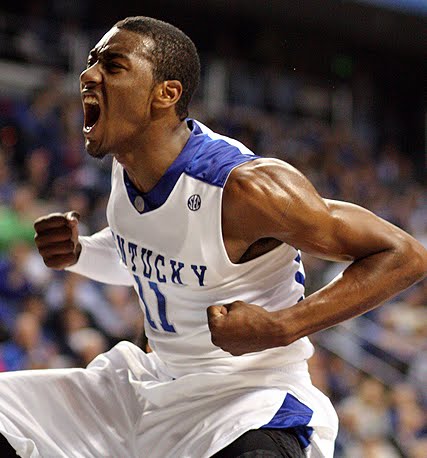
As the time gets closer to following the bouncing ping-pong balls for the NBA Draft Lottery Tuesday night, we already know the chance each team in the lottery has for winning the first overall selection, and thus showing the money to the consensus No. 1 pick, Kentucky guard John Wall (above).

Based on their performance -- or lack thereof -- this season, the New Jersey-soon-to-be-Brooklyn Nets have the best shot of securing Wall's services, 25 percent. The Minnesota Timberwolves are second (19.9 percent) with the Sacramento Kings third (15.6 percent).

The official NBA odds of each lottery club getting the first overall pick:

1. New Jersey / 25.0 percent
2. Minnesota / 19.9
3. Sacramento / 15.6
4. Golden State / 10.4
5. Washington / 10.3
6. Philadelphia / 5.3
7. Detroit / 5.2
8. LA Clippers / 2.3
9. Utah / 2.2
10. Indiana / 1.1
11. New Orleans / 0.8
12. Memphis / 0.7
13. Toronto / 0.6
14. Houston / 0.5

OK, fine. But during my morning ritual of exploring ESPN.com, I found a page that simulates the Lottery, and with a click of the mouse reconfigures the ping-pong ball combinations that make the Lottery results. I decided to make my own sample of 100 Lotteries and played 100 times. Yes, I do have a life, but not to worry -- it only took a few minutes; try it yourself at:

http://espn.go.com/nba/lottery2010/mockdraft

What I found was that while the first four spots played pretty true to form, there was a bit of rejockeying of positions beginning with the fifth spot. While the Washington Wizards have the fifth-best "official" chance at nailing down No. 1 (5.3 percent), my sample had the Detroit Pistons in that spot, which came up nine times (9 percent).

The woebegone Los Angeles Clippers, the Rodney Dangerfields of the NBA, can't get a break in my sampling, either. They have the eighth-best "official" chance at 2.3 percent, but their logo didn't show up once in my 100 tries. It was interesting that the Utah Jazz (ninth, 2.2 percent), Memphis Grizzlies (12th, 0.7) and Toronto Raptors (13th, 0.6) never came up, either.

Conversely, the New Orleans Hornets (11th, 0.8), popped up three times (3 percent) and the Houston Rockets (14th, 0.5) made one appearance (1 percent).

My unofficial odds of each lottery club getting the first overall pick, based on playing ESPN's NBA Lottery mock draft 100 times:

1. New Jersey / 22 percent
2. Minnesota / 20
3. Sacramento / 17
4. Golden State / 14
5. Detroit / 9
6. Washington / 7
7. Philadelphia / 6
8. New Orleans / 3
9. Indiana / 1
10. Houston / 1
11. LA Clippers / 0
12. Utah / 0
13. Memphis / 0
14. Toronto / 0

***

Thanks to my old high school friend and faithful blog reader Steve Conklin for pointing this out -- remember all the talk at the end of the NBA regular season about the Celtics and Doc Rivers parting ways? Funny that after the Celts' vanquishing of LeBron and the Cavs, all that talk has vaporized? It was Doc himself who once famously said, "When you win, you're a genius, and when you lose, you're an idiot." Lots of high IQ scores for Doc and the C's these days ...

On the flip side, not so high praise for Claude Julien and the Bruins (OK, so I was wrong about the B's). That loss is going to sting Boston for a long, long time. At least my personal quest for an all-Original Six Final is still alive, so I'm rooting hard for the Hawks and Habs.

Thursday, May 13, 2010

B's can still get an "A"


Not to despair, Bruins fans. Sure, you all want to jump off the Zakim Bridge, or maybe impale yourselves on the Bunker Hill Monument (both within visual contact of the TD Garden, for you out-of-townahs).

But it says here the Bruins will not become a footnote for posterity when they take the ice Friday night for Game 7 of their Eastern Conference semifinal series against the Flyers -- for history's sake, if nothing else.

First, there would be the ignominy of becoming only the third team in Stanley Cup Playoff lore to lose a seven-game series after gliding to a 3-0 lead. For the record, the only teams to accomplish that dubious feat were the 1942 Red Wings, who were overtaken by the Maple Leafs in the Cup Final, and the 1975 Penguins, who were similarly victimized by the Islanders in the quarterfinals.

By the way, it should be noted the Islanders lost the first three games and stormed back to force a Game 7 twice in consecutive rounds in '75. After they stunned the Pens, they forced the Flyers to a deciding contest in the semifinals, but lost Game 7. The "Broad Street Bullies" went on to down the Sabres in the Finals to win their second straight Stanley Cup.

From the Bruins' perspective, they've already staved off such an embarrassing defeat once in their history. In 1939, they jumped to a 3-0 series lead on the Rangers in the Cup semifinals before being forced to a Game 7 by losing the next three. But the B's won Game 7, and led by Roy Conacher and the "Kraut Line" of Milt Schmidt, Woody Dumart and Bobby Bauer, beat the Leafs in five games to win the Cup.

Here's a historic look at the six times we've found ourselves in such a situation, with the Team that forced Game 7 listed first:

Year / Team / Opponent / Result
2010 / Flyers / Bruins / ?
1975 / Islanders / Flyers / lost
1975 / Islanders / Penguins / won
1945 / Red Wings / Maple Leafs / lost
1942 / Maple Leafs / Red Wings / won
1939 / Rangers / Bruins / lost

The 2010 Bruins are also carrying the standard for the Original Six Clubs. Should they repel the Flyers and advance, they would face the hated Canadiens in the Eastern Conference Finals, marking only the third time since 1980 that two O-Six clubs would meet in a conference final, and it would also be the first time since 1979 that three Original Six teams would reach the conference finals, with the Canadiens and Blackhawks already holding their stamped tickets.

Original Six teams in Stanley Cup conference finals since 1980:

2009 - Red Wings def. Blackhawks, 4-1
1995 - Red Wings def. Blackhawks, 4-1
1986 - Canadiens def. Rangers, 4-1

So, Bruins, it's all up to you. The spirits of Eddie Shore and Dit Clapper wouldn't have it any other way.

Sunday, May 2, 2010

An Original idea


Somewhere, the ghosts of Jack Adams, Toe Blake, Eddie Shore and King Clancy are smiling. That's because for the first time under the NHL's current playoff format, instituted in 1993, four "Original Six" teams -- the Montreal Canadiens, Boston Bruins, Chicago Blackhawks and Detroit Red Wings -- have reached the Stanley Cup Conference Semifinals.

And a chance exists that we could see our first "Original Six" final since 1979, when the Canadiens bested the New York Rangers in games. Albeit not a terrific chance, as the Bruins are the only Original Six squad still alive that led their playoff series on Sunday morning, following their thrilling OT triumph over Philadelphia in their series opener on Saturday.

Just as interesting, should the Canadiens, Bruins, Blackhawks and Red Wings all manage to win their respective series, it would mark the first time in the expansion era that the Conference Finals would consist solely of Original Six franchises -- not to mention that a Hawks-Wings battle would feature two of the best uniforms in sports (see above).

It was a common occurrence for four or five Original Six teams to advance this far in the early years of the post-expansion era, which began when the NHL expanded to 12 teams before the 1967-68 season. But since the playoff format was changed in 1981-82, as teams now had to advance by defeating teams within their own division, then conference, only once -- in 1991-92 -- did five Original Six clubs (Rangers, Bruins, Canadiens, Blackhawks, Red Wings) advance this far.

In 1993-94, another switch was made to the current format, which seeds according to the top eight seeds in each conference, and until this postseason, there had never been a time when more than three Original Sixers had survived this long in this format.

Here's a closer look:

Original Six teams in Conference Semifinals
2010: Canadiens, Bruins, Blackhawks, Red Wings
2009: Bruins, Blackhawks, Red Wings
2008: Canadiens, Rangers, Red Wings
2007: Rangers, Red Wings
2006: None
2005: Lockout, season cancelled
2004: Maple Leafs, Canadiens, Red Wings
2003: None
2002: Maple Leafs, Canadiens, Red Wings
2001: Maple Leafs
2000: Maple Leafs, Red Wings
1999: Bruins, Maple Leafs, Red Wings
1998: Canadiens, Red Wings
1997: Rangers, Red Wings
1996: Rangers, Black Hawks, Red Wings
1995: Rangers, Black Hawks, Red Wings
1994: Rangers, Bruins, Maple Leafs

Times Original Six teams have reached conference semifinals since 1994
Red Wings: 12
Rangers: 6
Canadiens: 5
Blackhawks: 4
Bruins: 4
Maple Leafs: 4

Original Six Stanley Cup Finals in expansion era (since 1967-68)
1979: Canadiens def. Rangers
1978: Canadiens def. Bruins
1977: Canadiens def. Bruins
1973: Canadiens def. Blackhawks
1972: Bruins def. Rangers
1971: Canadiens def. Blackhawks

Thursday, April 29, 2010

A Capital offense


Back on March 31, I wrote about the possibilities of first-round upsets in the Stanley Cup Playoffs, focusing on the matchups between first-seed and eighth-seed teams. The focus was on the chances of the Montreal Canadiens, who squeaked into the playoffs, taking out Alex Ovechkin and the Washington Capitals, who won the President's Trophy for the NHL's best regular-season record.

On paper, it was a complete mismatch. But as the legendary King Clancy used to say, "Hockey's a slippery game -- it's played on ice." And so it was for the Caps, who have slid into the abyss of summer after being eliminated by the upstart Habs.

It was truly a monumental collapse; not only did the Caps become only the ninth 1-seed to be upset by an 8-seed in 34 series under the current NHL playoff format (26.5 percent), but became the first 1-seed in league history to lose a first-round matchup after holding a 3-1 series lead, as the Canadiens stormed back to win the final three games.

The Caps also became the fifth President's Trophy winner to succumb in the first round since the NHL moved to its current playoff system in 1994. That, after scoring a league-leading 318 goals during the regular season (Vancouver was a distant second with 272 goals) and netting a league-high 79 power-play goals.

In their seven-game loss to the Canadiens, the Caps were a woeful 1-for-33 on the power play (3.0 percent) and scored only one goal in each of the last three games of the series, all won by Montreal.

The series was clearly divided into two parts; through the first four games, when Washington took a 3-1 series lead, they averaged 4.75 goals, as Canadiens goaltender Jaroslav Halak had a pedestrian .880 save percentage (139 saves in 158 shots). But in Games 5 through 7, Halak was a hero as he stood on his head for a .978 save percentage and allowed only three goals in 134 shots.

There will be much finger-pointing in the nation's capital, most in the direction of Ovechkin, who has yet to translate his pulsating, exhilarating talent and style of play into postseason success, and has failed to make a dent into the territory firmly held by Sidney Crosby.

"There wasn't much I could tell them," Caps coach Bruce Boudreau said in the interview room. "I told them I feel exactly like they did. I thought we had a good chance to win the Stanley Cup this year. I would have bet my house that they wouldn't have beaten us three games in a row. We all feel as low as we can possibly feel, and we'll meet in a day and we'll discuss the shoulda beens, the coulda beens at that time."

Perhaps Washington forward Jason Chimera said it best.

"If someone came to your work and stepped on your desk or punched you in the head, that's how I feel," Chimera told ESPN.com. "You come for a long playoff run, and it doesn't happen. It's tough. Right now, it's weird."

Tuesday, April 27, 2010

The curious case of Terry Crisp


On Monday, Jacques Lemaire announced his retirement as an NHL coach, thus laying cement on his legacy as one of only 14 men in NHL history to win the Stanley Cup as a player and then as a head coach.

The list is awe-inspiring, containing some of the sport's most legendary and mythical names -- Jack Adams, Toe Blake, Hap Day, Lester Patrick, Al Arbour and Larry Robinson. In fact, of those 14, no less than 13 have a spot in the Hockey Hall of Fame.

Which leads us to the strange scenario involving Terry Crisp (above) -- the only man in NHL annals to win a Stanley Cup as a player -- twice with the "Broad Street Bully" Philadelphia Flyers in the 1970s -- and as a coach, with the 1988-89 Calgary Flames -- who is not a member of the Hockey Hall of Fame.

Crisp played 11 seasons in the NHL with four teams, and never scored more than 13 goals in any campaign. He was an effective defensive forward, who was once second in the league in short-handed goals, and faded a bit into the background on a team known for the offensive firepower of Bobby Clarke, Rick MacLeish, Reggie Leach and Bill Barber, the pugilistic prowess of Dave Schultz, Bob Kelly and Andre "Moose" Dupont, and the stellar goaltending of Bernie Parent.

Crisp retired in 1977, coached in Canadian Juniors and the minor leagues, and was named head coach of the Calgary Flames in 1987. He led Calgary to three first-place finishes, including the Flames' hoisting of the Cup in 1989, a team bolstered by 51-goal-scorers Joe Mullen and Joe Nieuwendyk. Despite the team's success, Crisp bickered with some of his key players, and he was dismissed as coach in 1990. He was the first coach of the expansion Tampa Bay Lightning in 1992, and coached the team for six seasons, never finishing higher than fifth place. Crisp is now a color analyst for Nashville Predators games.

Crisp is the co-holder of another NHL playoff record that's a statistical oddity; until last year, he was the only player in league history to play in the most Game 7s without a loss -- six. Alex Kovalev of the Canadiens tied that mark last season.

Here's the complete list of those who won Stanley Cups as players and coaches:
Name / Cups as Player / Cups as Coach
Jack Adams* / 2 (Tor. Arenas, Ottawa / 3 (Detroit)
Al Arbour* / 3 (Chicago, Toronto) / 4 (NY Islanders)
Toe Blake* / 3 (Mtl. Maroons, Montreal) / 8 (Montreal)
Frank Boucher* / 2 (NY Rangers) / 1 (NY Rangers)
Terry Crisp / 2 (Philadelphia) / 1 (Calgary)
Hap Day* / 1 (Toronto) / 5 (Toronto)
Cy Denneny* / 4 (Ottawa, Boston) / 1 (Boston)
Eddie Gerrard* / 2 (Ottawa) / 1 (Mtl. Maroons)
Tom Johnson* / 6 (Montreal) / 1 (Boston)
Jacques Lemaire* / 8 (Montreal) / 1 (New Jersey)
Lester Patrick* / 1 (NY Rangers) / 2 (NY Rangers)
Joe Primeau* / 1 (Toronto) / 1 (Toronto)
Larry Robinson* / 6 (Montreal) / 1 (New Jersey)
Cooney Weiland* / 2 (Boston) / 1 (Boston)

* Hall of Fame

Sunday, April 25, 2010

The NFL QB domino effect


Quarterbacks were a hot topic all weekend -- from Sam Bradford being selected No. 1 overall in the NFL Draft, to Tim Tebow going in the first round, to Jimmy Clausen waiting until the second round, to Colt McCoy going in the third, to the Raiders filling their hole at the position by trading for Jason Campbell, the erstwhile Redskin.

So hot, in fact, that when the NFL kicks off the 2010 regular season, no less than eight teams -- one-quarter of the league -- will be opening the campaign with new signal-callers. The biggest name that will go under center in a different uniform is Donovan McNabb, who was dealt from the Eagles to the Redskins in a rare trade between division rivals April 4. But there will be similar scenarios all over the league's landscape next season, with each move causing its own countermove -- a domino effect of sorts.

When Washington acquired McNabb, Campbell suddenly became expendable, and he was thus shipped to the Raiders on Saturday, ending the brief and pathetic JaMarcus Russell era (or is that error?) in Oakland. Campbell is also expected to start ahead of Derek Anderson, who signed with the Raiders as a free agent after finishing last season with the Browns.

Cleveland, in turn, drafted McCoy in the eighth round this weekend, but the Browns were quick to state McCoy will not start in his rookie season; that duty is expected to be performed by Jake Delhomme, who was beset by injuries and poor play with the Panthers next season.

Carolina took advantage of an opportunity by selecting Clausen in the second round of the draft. The Panthers, who finished last season with Matt Moore at QB, aren't tipping their hand, but with head coach John Fox in the final year of his contract, there will be plenty of pressure from Charlotte fans and media to give Clausen a shot.

In St. Louis, the Rams are trying not to put similar pressure on Bradford, but it would be shocking if he is not behind center on the opening play from scrimmage Sept. 12 against Arizona. The immortal Keith Null was the Rams QB in their final game last season. As for the Cardinals, Kurt Warner's retirement opens the door for Matt Leinart, known more for his playboy reputation off the field than for his performance on it.

And the Lions will turn their reins back to Matthew Stafford, whose rookie season was hampered by knee and shoulder injuries. Veteran Daunte Culpepper, who played out the string last year, is an unsigned free agent.

Here's a closer look at the NFL QB carousel:

Team / Starter, Week 17, 2009 / Projected starter, 2010
Arizona / Kurt Warner / Matt Leinart
Carolina / Matt Moore / Jimmy Clausen
Cleveland / Derek Anderson / Jake Delhomme
Detroit / Daunte Culpepper / Matthew Stafford
Oakland / JaMarcus Russell / Jason Campbell
Philadelphia / Donovan McNabb / Kevin Kolb
St. Louis / Keith Null / Sam Bradford
Washington / Jason Campbell / Donovan McNabb